
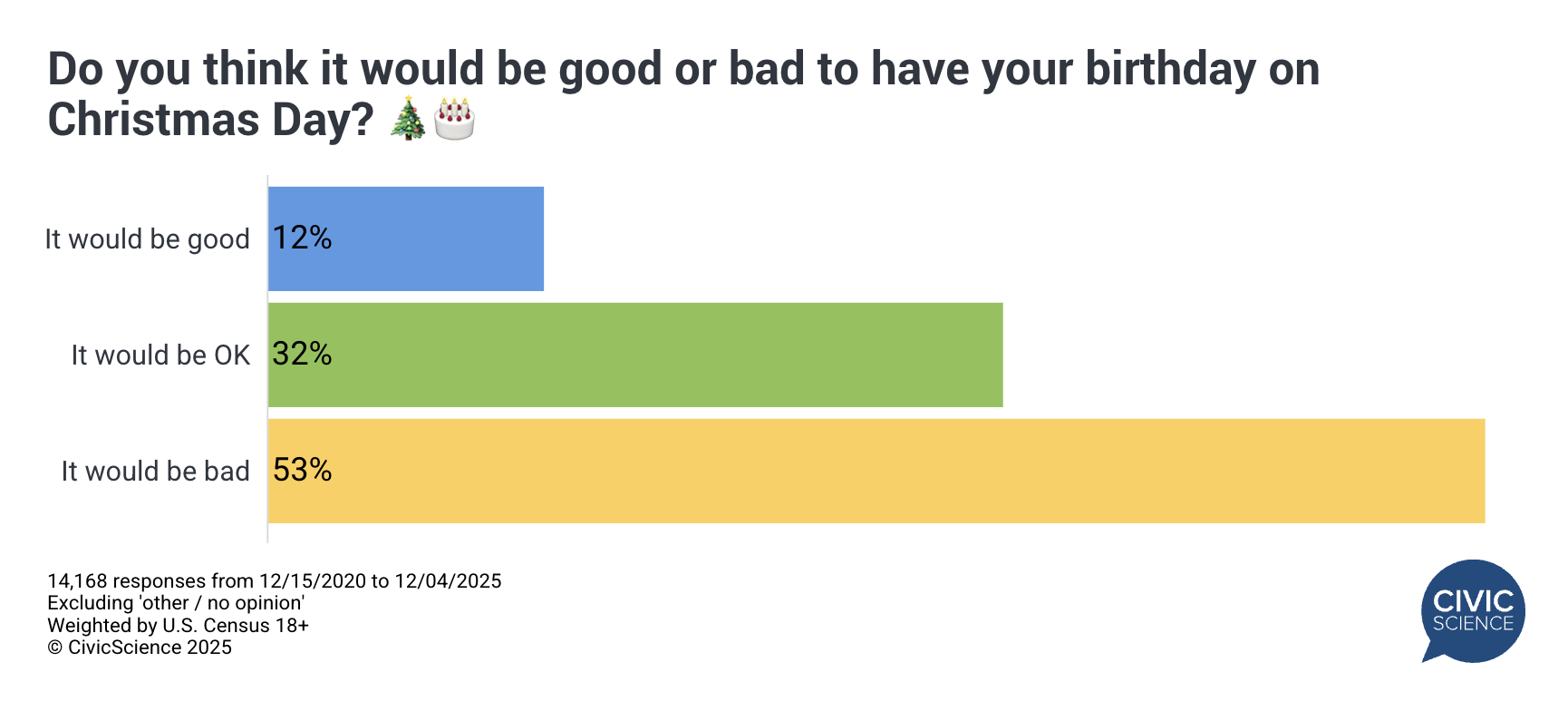
Would you want your birthday to land on Christmas? It’s a question many of us have wondered about at some point, and according to a new CivicScience poll of nearly 15K respondents, most Americans aren’t thrilled about the idea. Among those with an opinion, 12% say it would be good, 32% say it would be okay, and a clear majority (56%) say it would be bad to have a Christmas birthday.
Younger Americans under 45, especially those aged 18-29, are the most likely to say it would be ‘good,’ perhaps reflecting more openness to the novelty or shared celebration. Men and women share similar views on the idea. Regionally, Northeasterners and Southerners are somewhat more positive, and adults living in cities are also more likely to say a Christmas birthday sounds appealing.
But demographics aren’t the only thing setting Christmas-birthday supporters apart (among those with an opinion):
-
Buy Now, Pay Later: Those who say a Christmas birthday would be good are much more likely to have used Buy Now, Pay Later services—54% vs. about 20% of those who don’t want their birthday on the holiday.
-
Food Trends: They’re also more than twice as likely to enjoy plant-based meat (32% vs. 14%) and similarly over twice as likely to be favorable toward a keto diet (21% vs. 9%).
-
Discount Hunting: Nearly half say they use discount-retailer sites like RetailMeNot, compared to just 20% of those who oppose a Christmas birthday.
-
Corporate Social Responsibility: They’re roughly twice as likely to research a brand’s stance on social issues (43% vs. 24%), suggesting a stronger tendency toward values-based decision-making.
Whether you’d welcome the idea of sharing your birthday with Christmas or avoid it at all costs, the data shows the people who embrace it are distinct in their spending habits, food preferences, and even how they evaluate brands. For some Americans, doubling up on celebrations might not be such a bad thing after all.
Love taking polls? Sign up to participate in the Poll of the Day here.
This article’s data comes solely from CivicScience’s database, which contains nearly 700,000 poll questions and 5 billion consumer insights.