
Self-reported energy levels are a representation of countless factors. From lifestyle choices to the seasons and everything in between, it can feel impossible to track down exactly what creates a high or low energy experience on any given day. However, it is possible to view the connection between different energy levels and consumer intent.
As CivicScience data show, more than half (54%) of Americans rate their energy as “very” or “somewhat” energetic on an average day. By contrast, 27% say they’re not energetic “at all” and 19% say that it’s different each day.
Men outpace women in saying they are “very” or “somewhat” energetic (59% vs 51%), while women outpace men in saying it varies (22% vs 18%).Additional data show that younger adults and higher-income adults report having the most energy, while older and lower-income adults are more likely to say it depends on the day.
Since energy levels can offer a nuanced insight into consumer intent, here’s what the data show:
Spending Habits: Those who are the most energetic are also the most careful about their spending, outpacing those with the most variation in their energy by seven percentage points, and outpacing those with the least energy by 15 percentage points.
Grocery Delivery: Thirty-one percent of those who report having the most energy have used grocery delivery, followed closely by 28% of those who report having the least energy. Meanwhile, just 24% of those whose energy varies each day say the same.
Design Interests: Those who consider themselves “very” or “somewhat” energetic are five percentage points more likely than those with little energy and more than twice as likely as those with variable energy to follow trends in design and home improvement.
Book Preferences: While those with the most energy are the most likely to prefer print books (73%), outpacing all others with this preference by at least five percentage points, those with the least amount of self-reported energy slightly lead with a preference for audiobooks.
Bed Time: Perhaps not surprisingly, those who have the most self-reported energy lead in going to bed the earliest–between 8 and 10pm–by five percentage points. However, they also outpace all others who go to bed between 10 and 11pm by at least six percentage points. Those with the least energy or variable energy are more likely to go to bed after midnight.
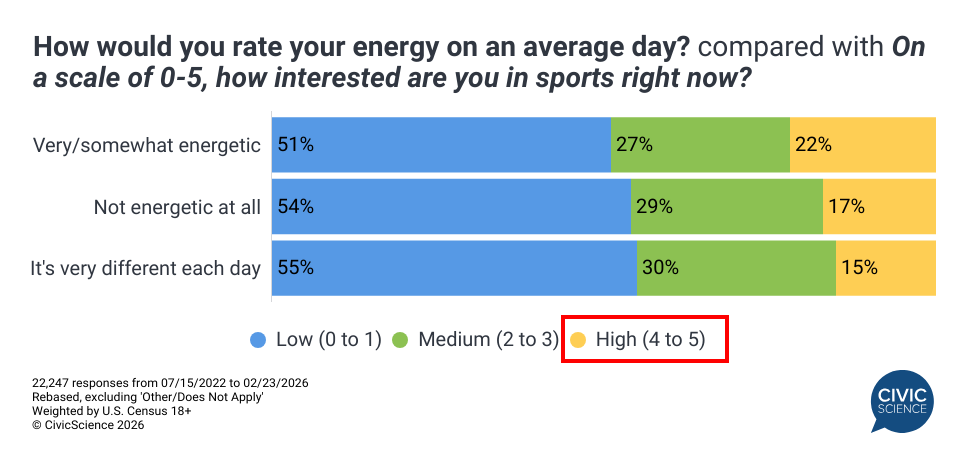
Sports Fandom: Those who report the most energy also report the highest interest in sports (22%), outpacing all others with the same level of interest by a minimum of five percentage points.
Clearly, energy levels are more than just a reflection of daily routines. They are also a potentially powerful indicator of how each group intends to spend.
Love taking polls? Sign up to participate in the Poll of the Day here.
This article’s data comes solely from CivicScience’s database, which contains nearly 700,000 poll questions and 5 billion consumer insights.