

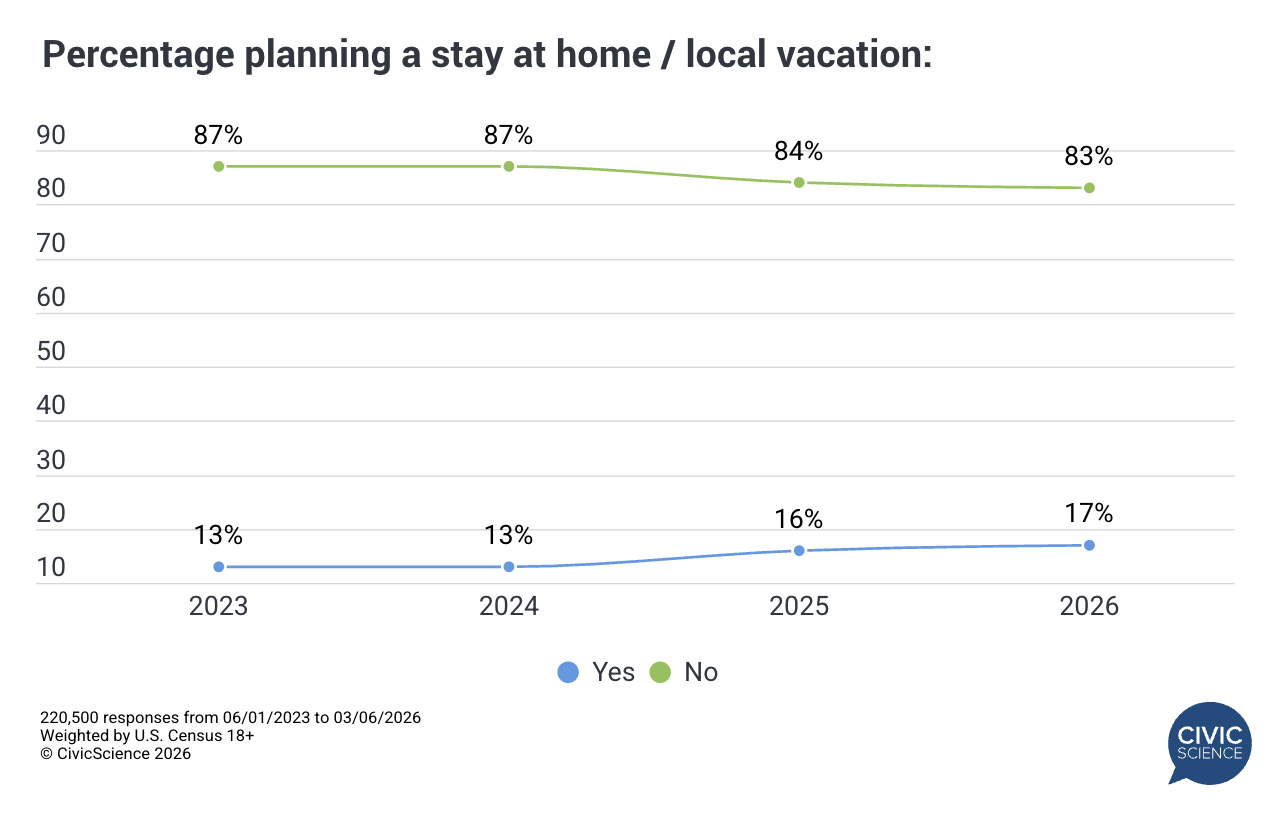
With spring break season approaching and warmer weather on the horizon, many Americans are starting to think about how they’ll take their next vacation. For some, that doesn’t mean boarding a plane or booking a long trip; it means staying closer to home. Over the last 90 days, 17% of U.S. adults told CivicScience they plan to take a staycation, defined as an at-home or local vacation. Interest in staycations has nearly doubled over the past few years, suggesting more Americans are embracing the idea of relaxing without traveling far.
Looking at staycation travelers over time, Gen Z adults show the strongest interest in these local getaways. Men and women report nearly identical levels of interest, and preferences are fairly consistent across income groups. Geography also shows only slight variation, though city residents report a slightly higher likelihood (19%) of planning a staycation.
But demographics aren’t the only thing distinguishing staycationers. CivicScience data reveal several behavioral and lifestyle differences between those planning local vacations and those who aren’t:
-
Family Travel: Those planning a staycation are 15 points more likely to say they enjoy going on trips with their extended family.
-
Vacation Outcomes: Staycationers are most likely to say they usually feel refreshed and energized after a vacation, while those who don’t take staycations are more likely to say they return from vacation feeling tired or sluggish.
-
Health & Fitness: Those planning a staycation are eight points more likely to say they maintain their health and fitness routines while on vacation.
-
Travel Preferences: When traveling long distances, staycationers are more likely to prefer driving, whereas non-staycationers are more evenly split between traveling by car or plane.
-
Travel Confidence: Staycationers are nearly twice as likely to consider themselves travel experts compared to those who don’t take these types of trips.
-
Vacation Length: Those planning staycations tend to report shorter vacations (under three weeks), while those who do not take staycations are more likely to report longer trips lasting three weeks or more.
-
Passenger vs. Driver: Staycationers are more likely to say they ride as a passenger during trips, whereas non-staycation travelers are more likely to say they drive.
As travel habits continue to evolve, staycations appear to be gaining traction as a practical and refreshing alternative to longer trips. For many Americans, a break doesn’t necessarily require going far—it just requires stepping away from the routine.
Love taking polls? Sign up to participate in the Poll of the Day here.
This article’s data comes solely from CivicScience’s database, which contains nearly 700,000 poll questions and 5 billion consumer insights.